My next group of friends are going on holiday to Phu Quoc and I needed some general information about the island.
I decided to collect all sorts of useful things in one post 😊
🇻🇳 Phu Quoc is the largest island in Vietnam , located in the Gulf of Thailand.
The island is 50 km long and 25 km wide.
🧒🏽👩🏽 Population: 148 thousand people according to 2020 data.
🌏 Language: Vietnamese, but a fairly large part of the population speaks conversational English, so we had almost no problems communicating on the island.
Or they used Google Translate.
💰 Currency: Vietnamese dong (VND).
💵 Currency exchange : Rate 1$ = 25,000 dong.
The rate fluctuates slightly, within a thousand dong, back and forth.
At the airport the rate is slightly lower than on the island itself.
For example, at the airport it might be 24, but at Long Beach in the city it might be 400.
So at the airport you can exchange $100 for a taxi, water and your first expenses, and then exchange the rest in the city.
Both old and new dollars are in circulation, but old bills from before 2006 will be accepted at a less favorable rate, but overall the difference is not significant, you will lose a couple of dollars at most.
Some exchange offices (reluctantly) accept yuan, but only in denominations of 100 yuan. We had great difficulty exchanging 50 yuan.
In general, the island is full of exchange offices, you can also safely go to massage parlors, shops and ask them to change money.
💵 Payment: Cafes, massage parlors, and stores prefer to accept cash, but we also paid by card.
In some places, for example, for excursions, they may accept payment in dollars.
There are also many ATMs on the island, not everywhere, but in key tourist areas they are.
We used a Visa card issued in Uzbekistan.
I can't tell you about Russian maps 😀
🚙 Transport:
You can get around the island by taxi, bus, or bike.
🚕 Taxi apps: Uber, Xanh SM.
You can also catch a taxi right on the street by waving your hand at them.
Payment by meter or by agreement. But it is better by meter, so that there are no surprises at the end of the trip, which taxi drivers all over the world love to arrange 😀
🚌 Buses: Download the VinBus app, select PhuQuoc, and it will show you all the routes.
A pleasant bonus for tourists is that there are 2 free (!!) buses running around the island – routes No. 17 and 19.
True, they go from the center from Long Beach to the north to Grand World (Venice), they do not go south to Sunset Town.
From Venice, where you can take free buses 17 and 19, you can get to Safari and VinWanders by transferring to free transfers V1, V2.
Bus #17 runs almost around the clock - from 4 am to 3 am, although during the day there are short breaks - 15 minutes each, and at night there is a break of 1 hour between flights.
In general, I'm not an expert on taxis and buses, we used a bike 😎🏍
🚗🏍 Transport rental: you can rent a car or bike on the island.
We took a bike.
There are many nuances to renting a bike—there's a separate post on that topic.
In general, renting a car and a bike is no problem; it’s easier and cheaper to rent it right on the spot rather than in advance.
Gasoline is cheap.
To drive a vehicle in Vietnam (and in Phu Quoc) you need an international license, but in fact, when renting a car, they don’t even ask for it.
🛣 Traffic: traffic on the island (as in all of Vietnam) is on the right, familiar to people from the CIS.
The traffic is very light, there is little traffic, especially on the main roads. The busiest traffic in the center of Duong Don is in the evening.
The maximum permitted speed in populated areas is 40 km/h, on main roads – up to 60 km/h.
Don't speed up too much, we've had a couple of cases where dogs suddenly jumped out in front of our wheels. And remember about the treacherous sand! On sand lying on the asphalt, the wheels can easily slip and the bike will fall over, so don't speed too much 😀😎
👮♂ Police : It's hard to see the police on Phu Quoc ; we only saw a traffic cop once in two weeks. There are no raids like in Phuket.
🙏 Religion on the island: ancestral religion, Cao Dai, Taoism, Buddhism, a small proportion of Christians.
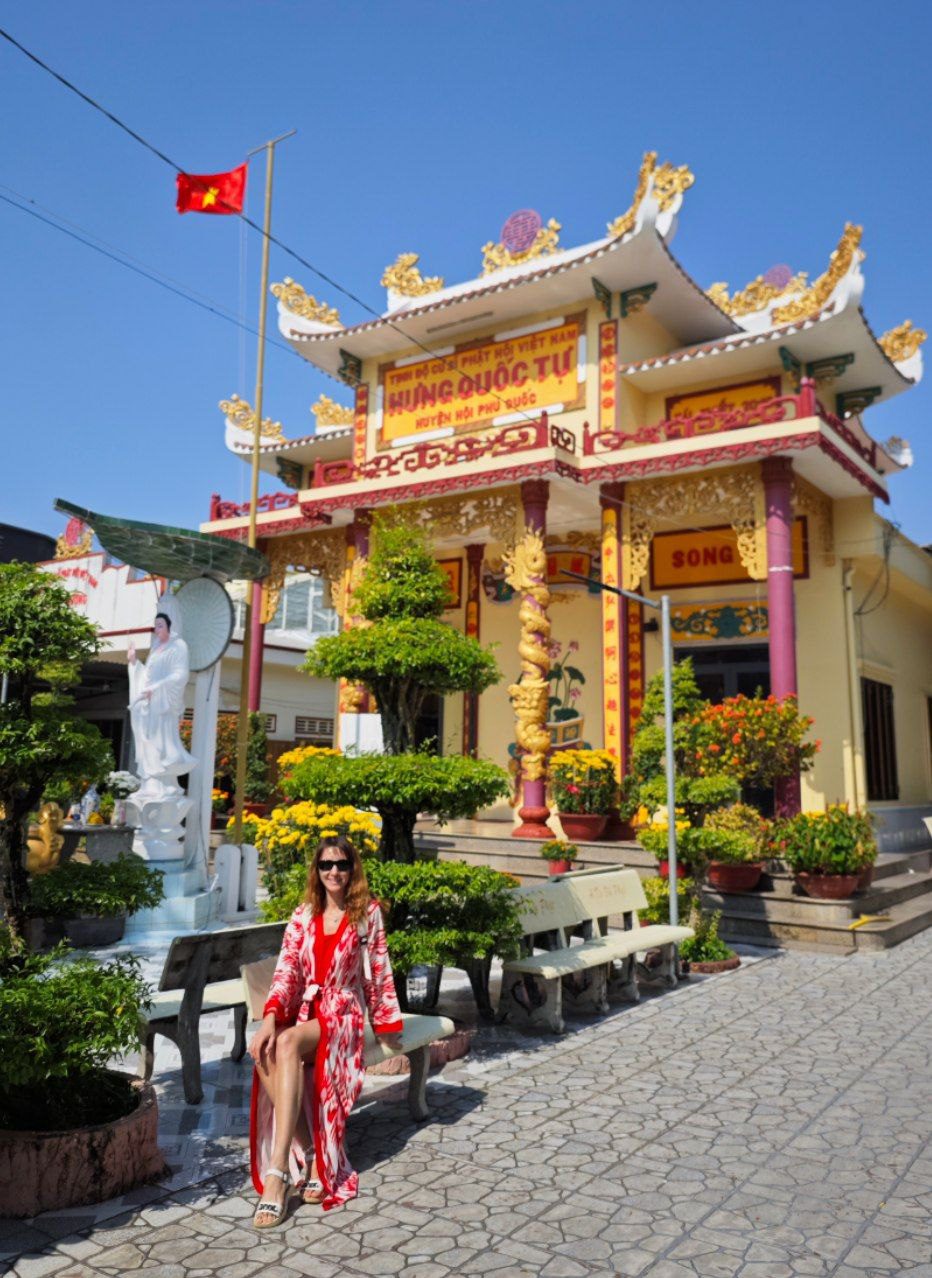
In temples, you must wear clothes that cover your shoulders and knees. You must take off your shoes inside the temple building.
⏰ Time zone: UTC +7
Very convenient for remote work 😀
It turns out to be +2 hours to Tashkent time. Accordingly, if it is 12 noon in Tashkent, then it is 14.00:XNUMX in Fukuoka.
💻 Internet: This is probably the first country in Southeast Asia we have visited where we had no problems with the network for remote work at all!
The Internet is very fast, we used mobile Internet with a local SIM card.
Plus, the hotel and ALL cafes and restaurants have Wi-Fi, which works quite well. We worked remotely and on it without any problems.
I remember our suffering in Sri Lanka, where it was simply impossible to work normally with the local mobile network - it didn't work, it crashed, it disconnected, it only worked on the veranda, it didn't work in the room, it only worked when the Moon was in the 5th House, and Capricorn was in Scorpio 😬😭😫
You can forget about Wi-Fi there altogether; several times in Sri Lanka we couldn’t even find a hotel with working Wi-Fi!
In Bali, in Phuket it was better, but the Internet was still slow and problematic for work, files took forever to download, the mits were hanging.
Here in Fukuoka everything just flew! 🚀
📲 SIM cards: We took local SIM cards at the airport. There is no difference in price between SIM cards in the city and at the airport.
We bought two different operators - we shared the risks, so to speak 😅 - Vinaphone and Vittel.
Both operators had good coverage - the whole island had good coverage, only once, when we went into the jungle behind the Suoi Tran waterfall, our network started to disappear. We had to crawl back out of the jungle😀
I got Vinaphone for 15 days for $8, the SIM card has a daily limit of 5 gigs, but I have never managed to reach this limit, although I spend a lot at work and make a lot of stories on Instagram 😀
My husband got Vittel for 30 days for $10 with the same daily limit.
In principle there were no problems, but for some reason my SIM card stopped working after 13 days 😀
Then my husband had to share the Internet with me from his SIM card for the remaining 2 days.
So it's better to play it safe and take it for 30 days. For $10, why not splurge? 😅
God bless Vietnam with such prices! I shudder when I remember how we in Turkey a year ago just paid 2 bucks at the airport for 100 SIM cards 😅
By the way, there are no problems with sharing a mobile network to a computer or other phones; operators allow this.
There were just such precedents in our travels, for example, in Kyrgyzstan, where after buying a SIM card it turned out that the operator puts a ban on network sharing and we can’t distribute the network to our computer 😫
If you are a tourist for up to a month, then my advice is not to bother and take a SIM card at the airport or on the street from any booth.
If you are staying for a long period of up to six months or longer, then it makes sense to bother with connecting at the office of the mobile operator.
When buying a SIM card, they didn't ask for passports. You give money - you get a SIM card, that's all 😀
It worked right away, without any long dances with tambourines, like in Kazakhstan, for example, where you have to register a SIM card with a foreign passport and set up a network.
😁 People: The locals are quite friendly. They certainly make money off tourists, but they don't try to rip them off at every turn. This isn't Turkey, where you always have to be on your guard, or, say, Sri Lanka, where almost every local is eager to take you somewhere, show you something, and then ask for tips.
We didn't notice any theft either. It's not like in Bali, where they warn you not to even hold phones in your hands while riding bikes, because they can be snatched out of your hands.
We often left things and even phones under things on the beach in Fukuoka, and we ourselves swam within sight of the things. Well, this is just to clear our conscience, so as not to feel completely irresponsible😅 But we still wouldn't have had time to run to the things if they had been grabbed😀
Laptops were sometimes left in the restaurant under the supervision of waiters.
Safety: It's very safe here. Even women can travel solo quite comfortably. This isn't like Sri Lanka, where I was downright terrified to be alone on the streets and where local guys would immediately start harassing me, even though I was wearing long, covered clothing.
🥃🍻🍹Alcohol: Alcohol is freely available in Fukuoka.
There is alcohol for every taste - from local rum and quite decent beer to bottled cocktails, from foreign alcohol like Baileys and Jack Daniels to delicious local myrtle wine.
Foreign alcohol is expensive, prices are about the same as in Tashkent, Almaty - it's about X2 of the duty-free price.
We tried several types of local rum (the photo shows the two most popular brands of rum) - we didn't like it - too strong and alcoholic. It'll go well with cola 😅
My favorites were the cocktails - Chill, Strongbow and Rio. All the flavors are cool, except for lychee and rose 😅
Prices for cocktails and beer in stores are very reasonable - $1-3 per bottle.
You can drink on the street, that is, if you walk with a can of beer or a cocktail, it’s not a problem, no one will arrest you or make a remark.
The main thing is to behave within the bounds of decency ☺️
???? Tips: In general, tipping is not very common here, the country is socialist, so the idea that a person works for a salary is close to their spirit. That is, if you do not leave a tip in a restaurant, a taxi driver, a baggage handler, then this will be perceived as completely normal.
But tourism does its “dirty” work – especially in touristy Fukuoka, where many foreigners vacation, and tipping is accepted in their culture – gradually, it is becoming more and more common to leave a “tip”.
We ourselves left small tips only in restaurants and cafes, in the amount of 20-40 thousand dong (1-2 dollars). We did not use taxis, we did not leave tips for any other services, except for one time, when a local caretaker began to take pictures of us in one temple,
then he gave us incense sticks, lit them and showed us how to ask the gods for blessings, and then stuck them into the stand in front of the altar.
Then he took a photo of us at each altar and at the temple building. He tried so hard to explain something to us without English and to make us like it, that we were very touched and gave him 50 thousand dong ☺️
It was an elderly man, about 65 years old, he didn't take a very good photo, but he did it so diligently, he made sure we checked the photos and re-photographed when he saw that his fingers were sticking out in the frame in several photos 😀
In general, we thought it would be impolite not to reward him for his efforts, so we left him some money ☺️
But I hope that over time Phu Quoc will not turn into a second Sri Lanka, where for any service, even one you don’t need (for example, showing you the way to a landmark), the locals will start asking for tips quite brazenly and persistently.
👗👔🩳 Dress: Except for temples, you can wear very short and revealing clothes everywhere - no one will look at you askance or lustfully, no one cares😀
I love short shorts and dresses, so here for me it was a real treat, like in Thailand - you can wear shorts during the day or at night, and the locals aren't particularly interested in you.
Just for the temple you need to take something closed with you, I used my favorite national robes-lifesavers ☺️😍
Even though they have socialism in their country, it doesn’t leave any strong imprint on their uniforms.
So, feel free to take short shorts and skirts to Phu Quoc 😀
For evening riding a bike, it's worth taking a windbreaker.
👙🩱🩲 Beach attire: Well, as you can already tell from the description above, you can sunbathe on the beaches even in the most revealing open string bikini. No one will even look, no one cares 😀
We even met one nudist at the plane meeting spot near the airport 😅
But this is a rather deserted part of Long Beach.
On crowded beaches, sunbathing topless and naked is still not accepted and it is better not to practice this, so as not to embarrass the people around ☺️
💧👟 Aqua shoes: not needed! There are no reefs here, and entry into the water is sandy everywhere.
???? Snorkeling masks: You don't have to drag them either, we dragged them in vain. In the end, we thought we'd at least find something interesting on Ong Lang Beach, but no, we didn't snorkel there either.
If you take a tour of 5 islands, then some snorkeling is promised there, but you can use a rental mask for one time, you definitely shouldn’t bring your own.